
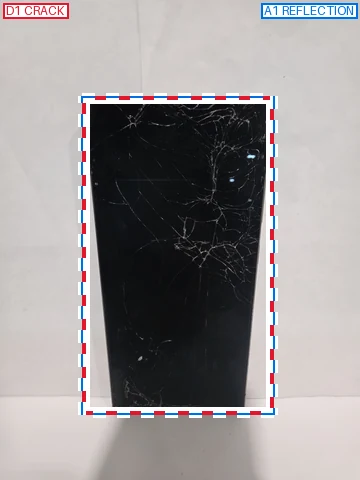
 Recorded Case 01
Front-glass cracks
Critical crack network
A critical central crack finding with inventory agreement makes this the clearest overview of how recorded evidence is presented.
Screen damage confirmed
Recorded inventory · Agreed
THE RECORDED LIBRARY
Explore 36 recorded VisionX inspections. Every annotated card opens a dedicated page with the original, web-readable overlay, outcome, limitations, and related cases.
Showing all 36 recorded inspections.
01 / FRONT-GLASS CRACKS
Recorded crack findings ranging from localized edge damage to broad crack networks.
Recorded Case 01Front-glass cracks
A critical central crack finding with inventory agreement makes this the clearest overview of how recorded evidence is presented.
Recorded inventory · Agreed
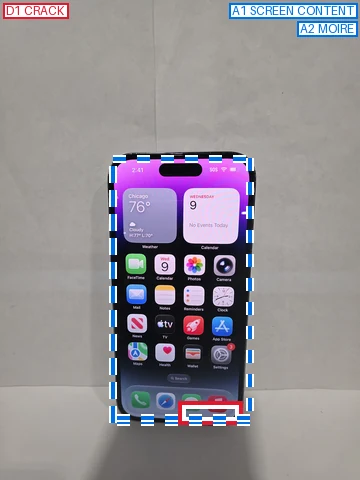 Recorded Case 02
Front-glass cracks
This record shows a localized high-severity crack rather than a full-screen damage field.
Recorded inventory · Agreed
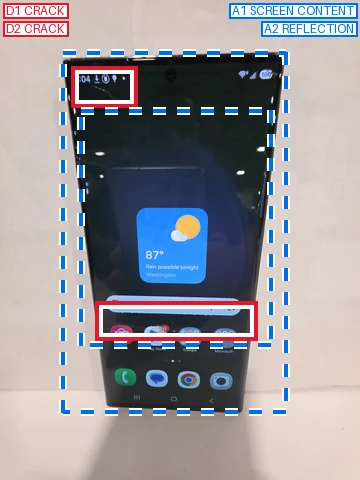 Recorded Case 03
Front-glass cracks
The canonical inventory retains both the upper-left and central findings instead of collapsing them into one label.
Recorded inventory · Agreed
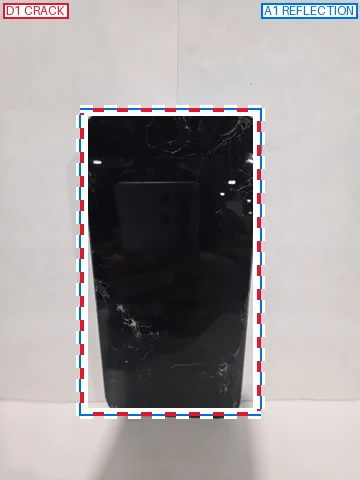 Recorded Case 04
Front-glass cracks
The recorded outcome is damaged, with one critical canonical crack region and a disclosed inventory dispute.
Exact finding inventory disputed
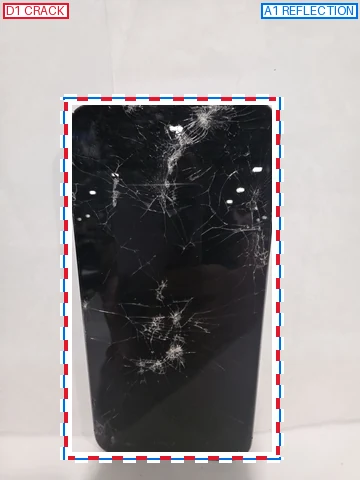 Recorded Case 05
Front-glass cracks
A broad canonical region communicates the recorded extent without pretending to trace each crack line.
Exact finding inventory disputed
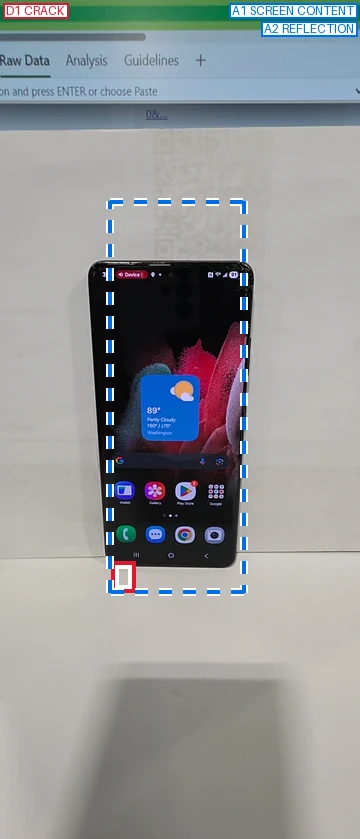 Recorded Case 06
Front-glass cracks
This case demonstrates why small canonical boxes need legible website strokes at card size.
Exact finding inventory disputed
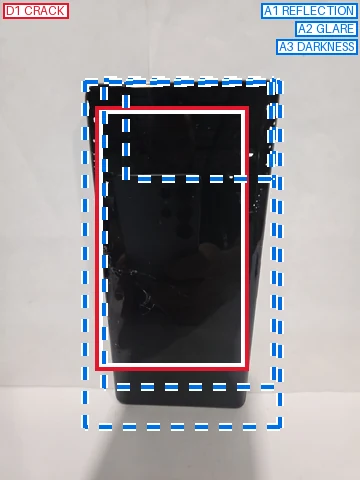 Recorded Case 07
Front-glass cracks
The evidence remains inspectable even though capture artifacts occupy much of the front glass.
Exact finding inventory disputed
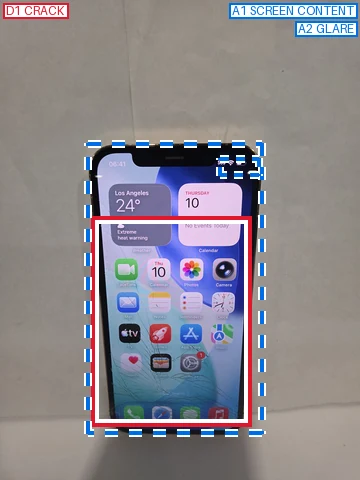 Recorded Case 08
Front-glass cracks
The canonical result separates the lower crack from the screen-content and glare artifacts in the same frame.
Exact finding inventory disputed
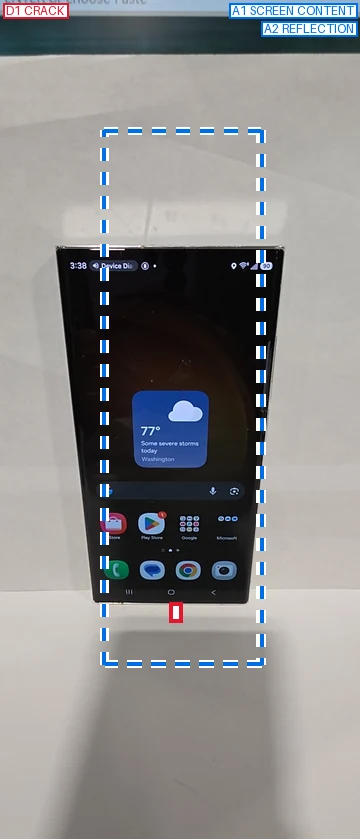 Recorded Case 09
Front-glass cracks
A small recorded boundary remains visible in the web presentation without enlarging its canonical geometry.
Exact finding inventory disputed
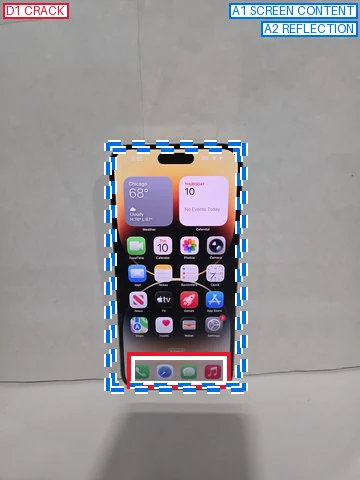 Recorded Case 10
Front-glass cracks
The record provides an agreed crack inventory while retaining the original display context.
Recorded inventory · Agreed
02 / CRACK AND CHIP
Views where more than one form of front-glass damage appears in the recorded inventory.
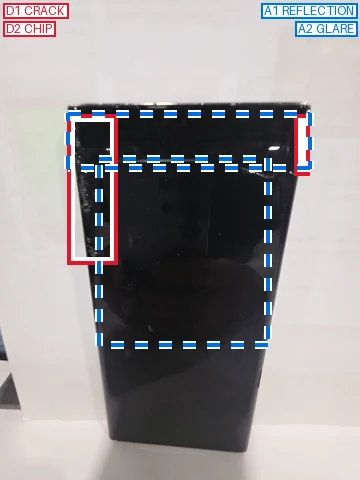 Recorded Case 11
Crack and chip
The recorded result preserves the crack and chip as separate canonical findings.
Recorded inventory · Consensus not applicable
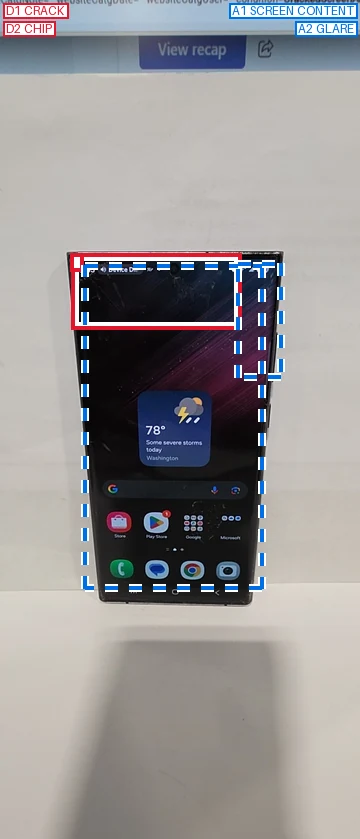 Recorded Case 12
Crack and chip
The different severity labels help reviewers distinguish a dominant crack from a more localized chip.
Exact finding inventory disputed
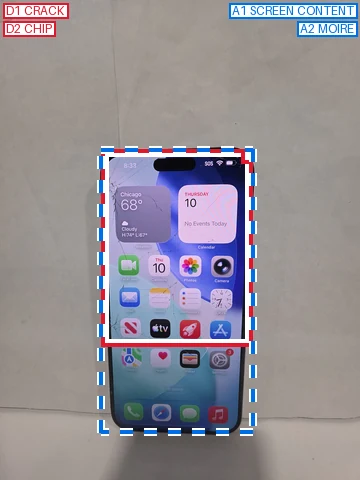 Recorded Case 13
Crack and chip
This record keeps the glass findings distinct from screen content and moiré artifacts.
Exact finding inventory disputed
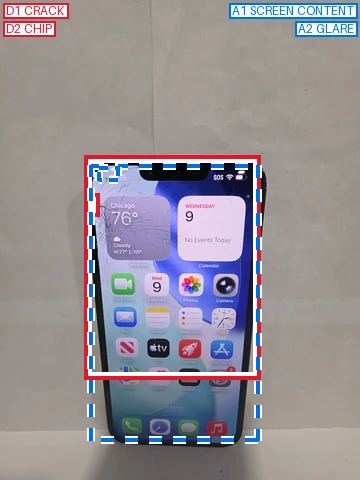 Recorded Case 14
Crack and chip
The overlay makes the two recorded boundaries inspectable without merging their labels.
Exact finding inventory disputed
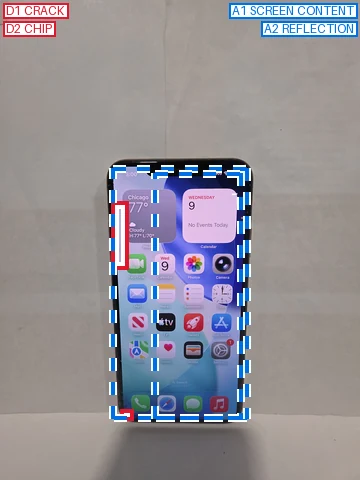 Recorded Case 15
Crack and chip
The recorded inventory differentiates a high-severity crack from a medium-severity chip.
Exact finding inventory disputed
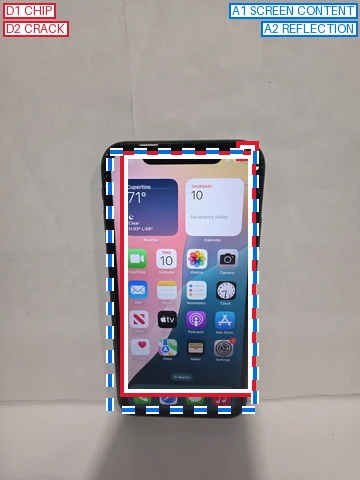 Recorded Case 16
Crack and chip
The canonical order retains the chip and crack as independent findings in the same damaged result.
Exact finding inventory disputed
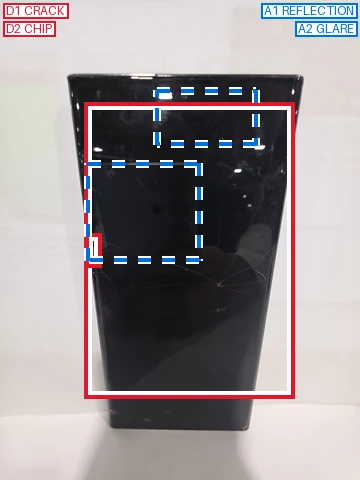 Recorded Case 17
Crack and chip
This case demonstrates a resolved damaged outcome with multiple severity levels and an inventory caveat.
Exact finding inventory disputed
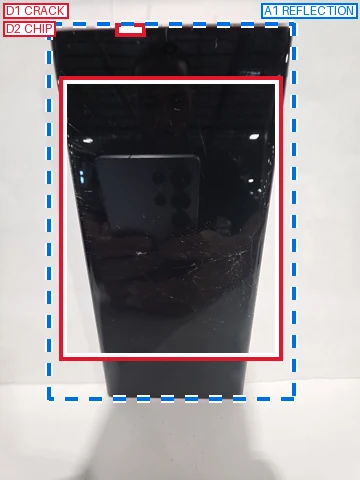 Recorded Case 18
Crack and chip
The full-frame view keeps the small top chip visible without cropping away device context.
Exact finding inventory disputed
03 / DISPLAY ANOMALIES
Display lines, dark regions, or shade/bleed discoloration recorded alongside glass damage.
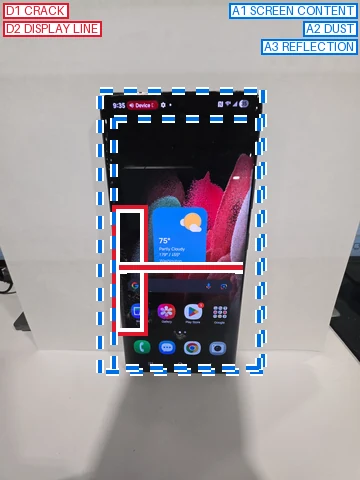 Recorded Case 19
Display anomalies
The canonical record separates display damage from glass damage while resolving one damaged outcome.
Exact finding inventory disputed
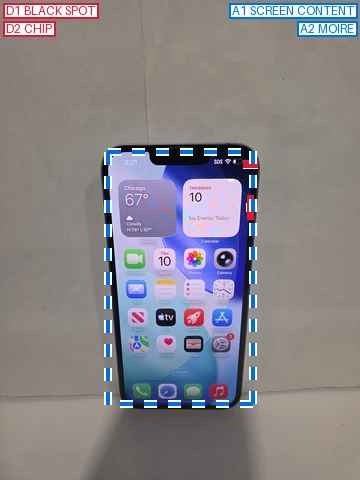 Recorded Case 20
Display anomalies
The thicker website overlay helps both compact findings remain visible without changing their boxes.
Exact finding inventory disputed
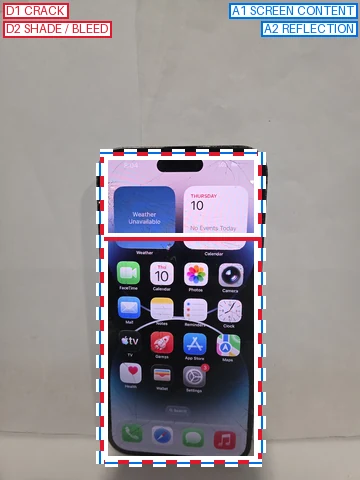 Recorded Case 21
Display anomalies
This is the B-variant hero: a resolved damaged result with clearly disclosed inventory disagreement.
Exact finding inventory disputed
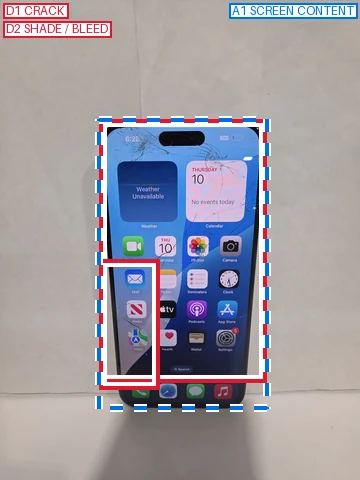 Recorded Case 22
Display anomalies
This companion case shows the same display-damage type in a different location and photograph.
Exact finding inventory disputed
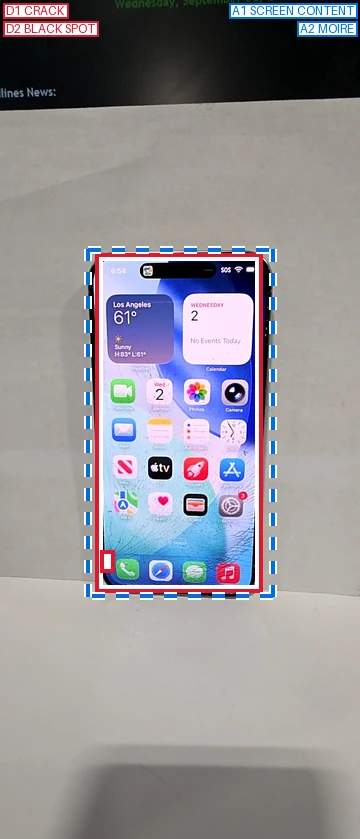 Recorded Case 23
Display anomalies
The case keeps a small display anomaly inspectable alongside more extensive glass damage.
Exact finding inventory disputed
04 / SCRATCHES
Light and heavy scratch-led records, including one mixed scratch and crack result.
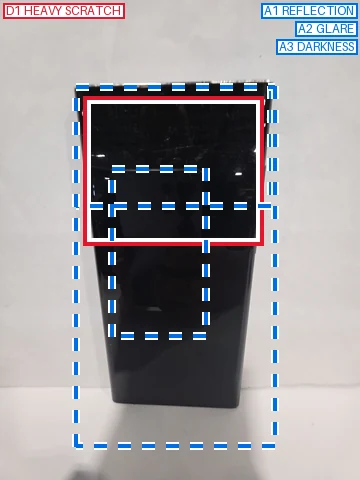 Recorded Case 24
Scratches
The result retains the scratch taxonomy instead of rewriting every linear mark as a crack.
Recorded inventory · Consensus not applicable
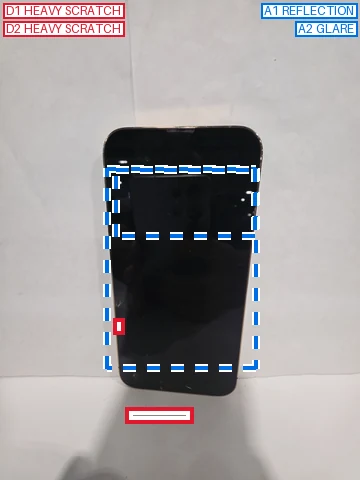 Recorded Case 25
Scratches
The canonical result preserves two locations rather than representing all surface damage with one box.
Recorded inventory · Consensus not applicable
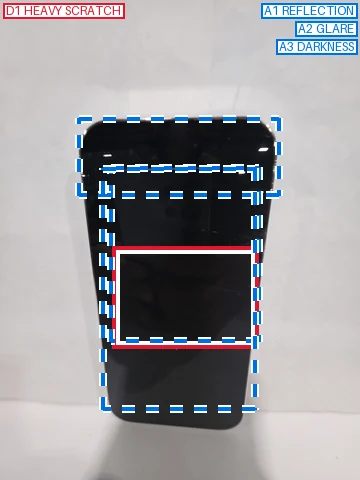 Recorded Case 26
Scratches
The web overlay distinguishes the damage boundary from overlapping reflection and darkness artifacts.
Recorded inventory · Consensus not applicable
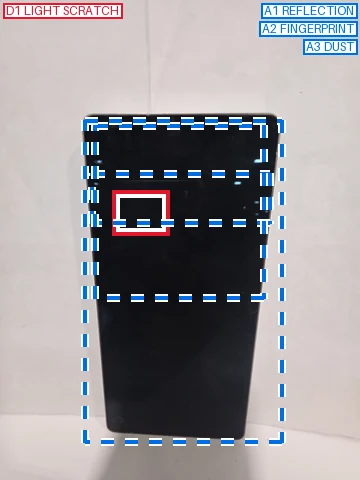 Recorded Case 27
Scratches
This case shows why damage findings and capture or surface artifacts remain separate lists.
Recorded inventory · Consensus not applicable
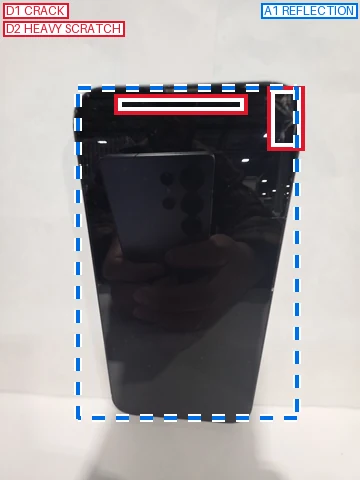 Recorded Case 28
Scratches
The mixed inventory demonstrates that scratch-led cases can still contain higher-impact glass damage.
Exact finding inventory disputed
05 / NO CONFIRMED DAMAGE
Usable photographed views where the recorded result confirmed no visible defect.
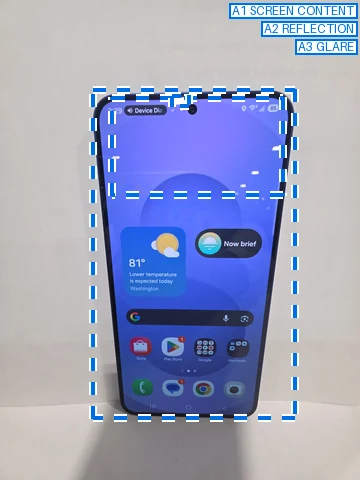 Recorded Case 29
No confirmed damage
The record demonstrates the scoped wording “no confirmed visible damage” for the supplied photograph.
Recorded inventory · Consensus not applicable
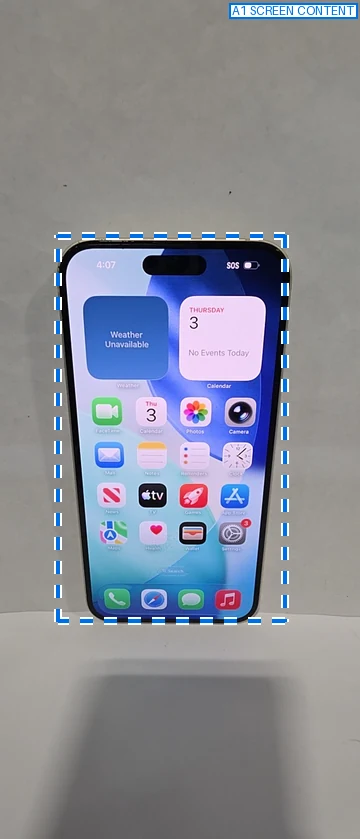 Recorded Case 30
No confirmed damage
Screen content is retained as a low-impact artifact rather than being mistaken for damage.
Recorded inventory · Consensus not applicable
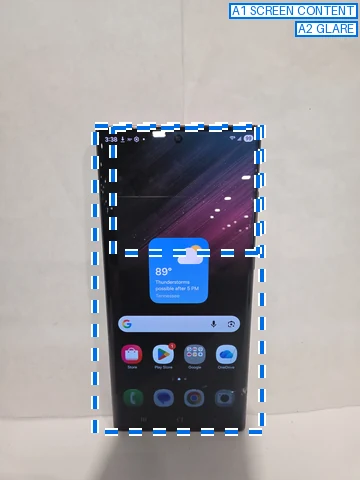 Recorded Case 31
No confirmed damage
The full-frame view keeps screen content and upper-screen glare visible as separate capture artifacts.
Recorded inventory · Consensus not applicable
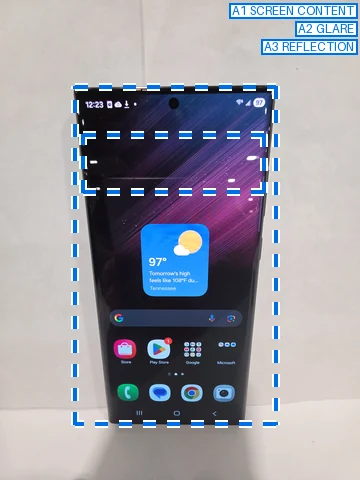 Recorded Case 32
No confirmed damage
No canonical defect was confirmed, while the capture artifacts remain visible for review.
Recorded inventory · Consensus not applicable
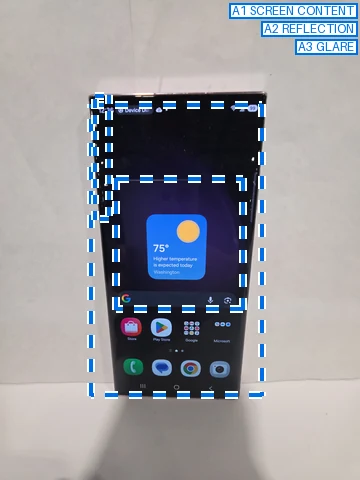 Recorded Case 33
No confirmed damage
The no-damage conclusion remains paired with its capture-quality context rather than presenting a synthetic clean view.
Recorded inventory · Consensus not applicable
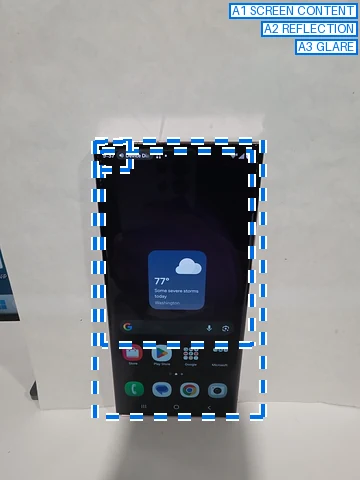 Recorded Case 34
No confirmed damage
The case broadens the clean set beyond bright studio displays while retaining artifact disclosure.
Recorded inventory · Consensus not applicable
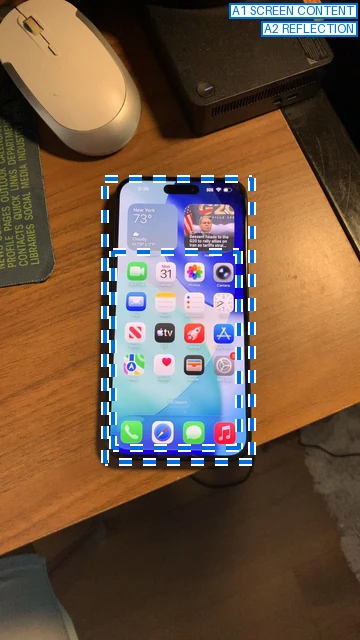 Recorded Case 35
No confirmed damage
This non-studio example shows the same evidence contract in a more everyday capture setting.
Recorded inventory · Consensus not applicable
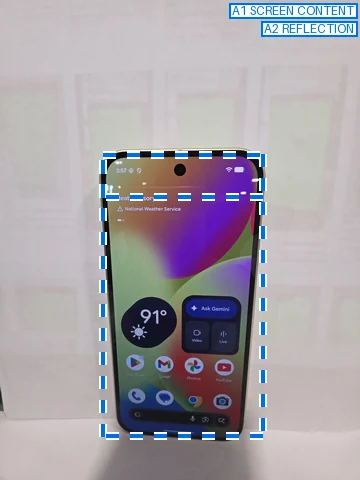 Recorded Case 36
No confirmed damage
The clean result remains paired with its original full frame and recorded screen-content artifact.
Recorded inventory · Consensus not applicable
HOW TO READ THIS LIBRARY
Recorded VisionX inspection. The source photograph was auto-oriented, metadata-stripped, and resized for web only. Recorded canonical findings were re-rendered with thicker web-only boundaries for readability; their geometry was not expanded or repaired. Results apply only to the photographed view and are not accuracy benchmarks, functional tests, or whole-device guarantees.
No customer identity or workflow provenance is inferred from these images. The scenarios on the Solutions page are illustrative.
Understand the review processTHE NEXT STEP
Use representative photographs from your real workflow to understand how capture conditions and decision rules affect results.